Care & Preservation
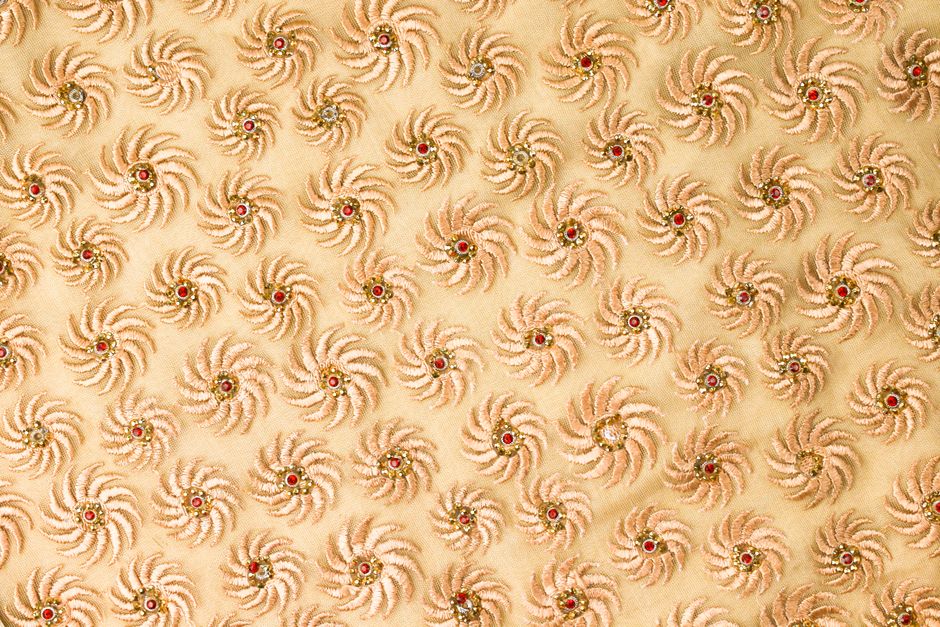
Few textiles announce themselves quite like brocade. The name comes from the Italian broccato, meaning embossed or raised, and it describes any fabric in which an additional weft is woven into the ground to create a pattern that sits proud of the surface. That supplementary weft is often metallic, silk, or both, which gives brocade its characteristic shimmer and its unmistakable weight in the hand. For centuries, brocade has been the fabric of courts, ceremonies, and sacred spaces, and it retains that aura even in a modern interior.
The technique is ancient and appears independently in many cultures. Chinese silk workshops produced elaborate brocades for imperial use as early as the Han dynasty, and the tradition continued through the Tang and Ming periods with increasingly complex dragon and cloud motifs. In the Islamic world, Persian and Ottoman weavers developed their own brocade vocabularies, often using flat metallic thread and tight geometric repeats. By the Middle Ages, brocade production had taken root in Italy, particularly in Lucca, Venice, and later Lyon, where European weavers adapted and transformed the techniques they had learned through trade.
When examining a brocade, start with the ground. A damask ground with a satin face will catch light differently than a plain tabby ground, and that interaction is part of the design. Then look at the pattern weft. Real metallic thread, sometimes called passing, is usually a thin strip of metal wound around a silk core, while imitation metallic is a coated film or plastic. The real thing tarnishes, patinas, and occasionally sheds, but it also has a depth that imitation rarely matches. Pattern repeats matter as well: hand-drawn repeats can be slightly irregular, while jacquard-woven repeats are mechanically perfect.
Motifs shift with fashion and politics. Large-scale floral and foliate designs dominate certain periods, while geometric and architectural patterns dominate others. Color palettes are equally telling. The deep reds, golds, and blues of many historical brocades reflect both available dyes and sumptuary traditions, where certain colors were reserved for specific ranks or occasions. Learning to recognize these signals turns a beautiful textile into a readable document.
Modern collectors encounter brocade in several forms: fragments from historical garments, furnishing lengths from grand houses, ecclesiastical vestments, and theatrical costumes. Each has its own market. Fragments are often the most affordable entry point and can be framed or used in small projects. Furnishing lengths are prized for their scale and can be difficult to store, but they show the pattern to full advantage. Vestments and theatrical pieces carry provenance that can dramatically affect value, so documentation matters.
Condition is the great equalizer. Brocades are prone to splitting along the pattern weft, especially where metallic threads have stiffened or where folds have stressed the ground. Look for shattering, tarnish, and repairs before you fall in love with the surface. When buying online, ask for backlit photographs and close-ups of the reverse, which reveals more about structure than the front ever will. Store brocades flat where possible, pad the folds, and keep them out of direct light. Handled with care, a good brocade rewards its owner with something rare in any era: the sense of holding a piece of deliberate, unhurried luxury.
